 |


 |
                             |
|
Steamrunner-Class Light Cruiser UNITED FEDERATION OF PLANETS: STARFLEET DIVISION Advanced Technical Specifications for the Steamrunner-Class Production Vehicle
1.0
STEAMRUNNER-CLASS
INTRODUCTION Pursuant to Starfleet Exploration Directives 902.3 & 914.5, Starfleet Defense Directives 138.6, 141.1 & 154.7, and Federation Security Council General Policy, the following objectives have been established for a Steamrunner Class Starship (CLU, LCL):
Overall
Length: 300.98
meters Primary
Hull Dimensions - 8 decks Secondary
Hull Dimensions - 4 decks Nacelle
Dimensions Weight: 585,000 metric
tons Hull: Duranium-Tritanium composite with micro-fiber
reinforced ablative armor over critical compartments.
Editor's Note: History written by Steve Mallory and Robert Pate - based on information found in Star Trek: First Contact, Star Trek: Voyager, Star Trek Technical Manual, Star Trek: The Next Generation Technical Manual, Star Trek: Deep Space 9 Technical Manual, and Star Trek: The Magazine. The style of the history is based on histories presented in the Startrek Spaceflight Chronology by Stan Goldstein, Fred Goldstein, and Rick Sternbach. Please keep in mind that this is a history developed based on canon information presented in various sources and filled in with logical conjecture. One
of the last vessels designed and launched before the debacle at Wolf
359,
the Steamrunner Class of starships was the quintessential utility
vessel of
Starfleet. The class was originally designed as a replacement for the
elder
statesman of the fleet, the Miranda class, in the role of cruiser and
deep space
fleet escort.
The Steamrunner Class was born out of necessity.
The Miranda Class had long
since passed its expected service life by more than 75 years. In that
time,
Starfleet had yet to find an adequate replacement for the multi-role
Miranda-class, so the call went out to the fleet yards of the United
Federation
of Planets for a new, small vessel, capable of adapting to multiple
roles, to
supplement and ultimately replace the Miranda class. Soon after the basic concept for the Steamrunner was outlined, Starfleet did a 180-degree change in its direction for the "Master Plan for the Fleet" and concentrated on developing larger, multi-mission oriented vessels. It wasn't until the late 2340's that Starfleet again decided to expand its smaller, mission-specific fleet. Reviewing the design concept for the Steamrunner, Starfleet gave the go ahead and the project finally continued. Construction of the first prototype hull, still
bearing the designation
NX-52000, began in 2353 in Arm 3 of the Nesrun Shipyards. The nacelle /
primary
hull assembly was completed within the year, and both the Primary and
the
Auxiliary Computer Cores were put in place by the end of 2354. Owing to the unique design of the Hull, and that
the impulse engines were
originally designed for a much larger vessel, some severe modifications
to the
NX-52000 hull took place. The most visible modification was the
extraction of
the primary Warp deflector array from the primary hull. The Deflector
was
mounted 'outboard', in a pod strung by structural beams between the
Warp
Nacelles. This unique configuration was not the most efficient manner
of
reconfiguring the deflector network, but it was the most expedient. Soon, the CL was redesigned to be fitted with new Type X phaser arrays, and the torpedo launchers were made largely automated to allow for a higher volume of firepower. This gave the Steamrunner class unprecedented firepower for its size, second only to the size to firepower ratio presented in the Defiant class project. Owing to the number of Steamrunner Class vessels that were in active service, and complexity of the refits ordered by Starfleet, the turn-around time for these 'new' Steamrunners was excessive. Over 20 refits were completed at Utopia Planitia
and Station McKinley by the
time the second Borg Incursion occurred. Of those 20 Steamrunner Class
vessels
that participated in the defense of Sector 001, nine Steamrunner class
vessels
were destroyed and five suffered significant enough damage that
Starfleet
decided to scrap the hulls. Of the six that survived the battle and
were still
space worthy, the most notable was the USS Appalachia. Several small modifications have since been made to the refit specifications on the Steamrunner Class, including the addition of EMH technology in Sickbay and Ablative Armor to the nacelle and Deflector dish assembly.
General Overview: Primary operational control for the ship is provided by the Main Bridge on Deck 1, which is located at the top of the primary hull. The Main Bridge directly supervises all primary mission operations (with the exception of the shuttlebay flight ops) and coordinates all departmental activities. The Main Bridge is a highly restricted area; only personnel with security clearance of Level 4 or above (officers of Ensign rank or higher) and authorized bridge personnel are allowed on the bridge. All bridge officers have access to type-I and type-II phasers. The Main Bridge is an exchangeable module, allowing for a wider variety in mission parameters. Layout: The central area of the Main Bridge provides seating and information displays for the Captain and the Executive Officer (the XO sits on the Captain's right). The two Officer chairs are equipped with fully programmable consoles for a variety of uses. Directly fore of the command area is the Flight Control section, which faces the main viewer. The FCO is equipped with a console that forms an almost 180-degree half circle, and has priority links to the navigational sensor and deflectors, as well as to the Warp/Impulse/Thruster propulsion systems. This console also has links to engineering controls and monitors (such as the SIF, IDF, hull integrity monitor, and structural stress monitors), as well as access to the tractor beam controls. At the very front of the bridge chamber is a large viewscreen. This main viewer performs all the standard duties expected of it, including communication and magnified visual scans of nearby objects.. To the left of the command area (when facing the Captain's chair, from the main viewer, or on the Captain's right, when seated in the Big Chair) is an elevated platform on which is located the Tactical/Security control station. Comprised of two consoles, one built into the wall and one extending into the bridge, Tactical forms a 'U' shaped alcove. Tactical console usage is extremely limited; only level 4 (or above) Tactical clearance personnel can use it, and the user must input special codes to even get access to the massive amounts of computer links that give tactical nearly limitless information from the ship's sensors and computers. For full access, the console's security subsystem can run a battery of scans on the user, including thermal, biological, retinal, and vocal tests. If all of these are passed, full access to the ship's offensive and defensive systems is made available. Between the Tactical station and the Engineering station is a turbolift entrance and access to inter-deck ladders. Also located in this area is the access to the maintenance crawlspace within the bridge walls. Against the left rear wall of the bridge is a large master systems display monitor (MSD), similar to the one in main engineering. All relative ship information (such as damage, power distribution, etc.) is displayed on the cutaway image of the ship. This monitor can be used to direct ship operations and can be configured for limited flight control if necessary. In front of the MSD, extending into the bridge in a 'c' shape, is the Engineering Console. The Engineering I console has priority links to the WPS (Warp Propulsion System), the IPS (Impulse Propulsion System), the SIF (Structural Integrity Field), the IDF (Inertial Damper Fields), as well as to the tractor beam system, to the computers and to navigational controls. Although usually unattended, the Chief Engineer can bring this console to full Enable mode by entering voice codes and undergoing a retinal scan. Directly right of the MSD (centered in the back of the bridge) are the Engineering II and Science II consoles. The Engineering II console is fully programmable to run any Secondary Console function, including Sciences, Medical, Operations, Limited Helm control, or Security. This console, as does every console on the bridge, also has the hand-input sub-console for use in setting the auto-destruct system. The auto-destruct sequence follows Standard Starfleet security procedures which can be accessed via any secured Memory Alpha ODN connection. Science II is the ASO's (Assistant Science Officer's) console, which can be used by any personnel. Science II has access to all science, navigational, sensor, and communications systems. Science II can be configured to operate in tandem with Science I, although security links and all other non-science data is withheld from Science II. Science II usually works independently of Science I. Science I is the primary science console and has priority links to the Main Computer, to all sensors and to all probes, as well as to Flight Control, Operations, and Tactical functions. It extends from the right rear wall into the bridge area, forming a reversed 'c', in a mirror image of the Eng I console. This station is always manned. Between Science and Operations is the entrance to the Captain's Ready Room, located behind the rear wall of the Bridge. Also located in this area is the entrance to the bridge's head (restroom), a second turbolift, and access to inter-deck ladders. To the right of the Captain's chair (on the Captain's left when seated in the chair) is the Operations manager's console. The Operations console is identical in size and design to the Tactical/Security. The Operations console, due to the tremendous amount of sensitive information found there, has security protocols as stringent as the TAC consoles. Built into the wall behind the Ship Operations Console is the Mission Operations Console, for use during Away team missions.
Located on Deck 7, Main Engineering is the ‘heart’ of the ship, comparable to the bridge as the ‘brain’. It has access to almost all systems aboard the starship, and manages repairs, power flow, and general maintenance. Off to the starboard side of Main Engineering is the Chief Engineer’s Office, which is equipped with a diagnostics table, assembly and repair equipment, a small replicator, a personal use console with built-in private viewscreen and a private bathroom. Entrance to the primary engineering spaces is provided by large blast doors on decks 7, that can be closed for internal or external security reasons, as well as in case of emergencies. Just inside of the doors on deck 7 - Main Engineering - is an observation area where technicians monitor various systems of the ship. Also in that area is a floor-mounted situational display similar to the Master Systems Display found on the Bridge. Affectionately referred to as the ‘pool table’, the Chief Engineer can use the display to more easily get a broad view of the situation with just a glance. Farther in from the observation area is the warp core and the main control systems. The core is a 'tower' that extends upward into deck 6. On this deck a balcony surrounds the core. The core can be ejected out of the bottom of the ship, if needed to avoid a breech. Circular in shape, but exceedingly functional to save space inside the ship, Main Engineering has usable consoles mounted on every piece of ‘real estate’ around the circumference of the room and provides primary control access for the engineers and technicians. Additionally, there are numerous ladders and access panels to Jefferies tubes, which lead throughout the ship. The technical complexity of the starship dictates the use of these spaces to maintain peak efficiency and affect proper repairs. The Matter/Anti-Matter Assembly (M/ARA) is what primarily makes up the warp core 'tower'. This is where primary power for the ship is generated inside the Matter/Anti-Matter Reaction Chamber (M/ARC). This system is checked on a regular basis due to its importance to the ship. Access to the warp core is restricted, with a front port to get to the Dilithium matrix as well as a side port for access to the warp plasma conduits. Deuterium Storage and Anti-Matter Storage Pods, the fuel components for the M/ARA, are stored on deck 8, where they are piped to the intake valves on the warp core. Both fuels can be ejected out of the bottom of the ship, as can the warp core itself.
This multi-room department is located in a restricted area on deck 7. Within it are the entrances to the phaser range, the Brig, the torpedo/probe magazine, the auxiliary weapon control room and to the Ship's Armory, as well as the Chief Tactical Officer's office. The CTO's office is decorated to the officer's preference. It contains a work area, a personal viewscreen, a computer display, a replicator, and a washroom/head. It is located next to the brig. Brig: Located on deck 7, the brig is a restricted access area whose only entrance is from within the Security department. The Steamrunner class vessel has 4 double occupancy cells, which contain beds, a retractable table and chairs, a water dispenser, and a toilet. The cells are secured with a level-10 forcefield emitter built into each doorway. Internal Forcefields: Controlled from the bridge or from the Security office on deck 7, forcefields can be activated throughout the ship, effectively sealing off sections of the hallway from the remainder of the vessel. Internal Sensors: Used to monitor the internal security of the ship. They can identify the location of specific crewmembers who are wearing their commbadge. They can be used to determine the general location of any person on board the ship, based on the entry of specific variables by the Tactical officer. Phaser Range: The phaser range is located on deck 7. The phaser range is heavily shielded and the walls are armored. It is designed for low level phaser fire, but can withstand short phaser blasts at setting 16 without a problem. The phaser range is used by security to train ship's personnel in marksmanship. During training, the holo-emitters in the phaser range are activated, creating a holographic setting, similar to what a holodeck does. Personnel are "turned loose" either independently or in an Away Team formation to explore the setting presented to them, and the security officer in charge will take notes on the performance of each person as they take cover, return fire, protect each other, and perform a variety of different scenarios. All personnel on Starfleet vessels are tested every six months in phaser marksmanship. There are 25 levels of phaser marksmanship. All personnel are trained in the operation of phaser types I and II up to level 14. All security personnel must maintain a level 17 marksmanship for all phaser types. The true marksman can maintain at least an 80% hit ratio on level 23. Ship's Armory: This room is located in a restricted area on deck 7 and is under constant guard. The room is sealed with a level-10 forcefield and can only be accessed by personnel with Alpha 3 security clearance. Inside the armory is a work area for maintenance and repair of phasers as well as multiple sealed weapon lockers. The armory carries enough type-I and type-II phasers to arm the entire crew. Type-III phaser rifle and the new compression phaser rifles are available as well, but only in enough numbers to arm approximately 1/3 of the crew. Heavy ordinance is available in limited numbers. Torpedo/Probe Magazine: This restricted area is for storing unarmed photon torpedoes, quantum torpedoes (if the mission dictates), and science probes type I - VI and type IX (types VII and VIII are available if the mission dictates). Also stored here are the components for manufacturing new photon torpedoes, as well as the equipment to put it all together. This room is also accessed by the loading mechanism for the torpedo launchers.
Arrangement: Three dorsal phaser arrays on the primary hull. The main array, extending in a 120 degree arc, is located just forward of the bridge module. Due to its recessed nature, set within the sunken hull that extends from the leading edge of the saucer to the bridge module, the field of fire (FOF) for the dorsal array is limited. The FOF can only be declined 10 degrees with a 85 degree arc of fire. The FOF can be inclined 160 degrees with a 300-degree arc of fire, or 135 degrees with a 360-degree arc of fire. The final two dorsal arrays are located aft of the Bussard Collectors on the port and starboards (P/S) sides. Their positioning allows for FOF coverage from lateral attacks as well as attacks from above. They also provide some limited coverage to the "6 o'clock" (directly aft). Four ventral phaser arrays on the primary hull. The twin primary arrays are located slightly forward of the dorsal phaser array placement. Due to the angle of the ventral aspect of the hull, the FOF can be inclined only 5 degrees, and declined 170 degrees, for a full 360-degree arc of fire. The final two ventral phaser arrays are located under the impulse engine housing. Their FOF covers the "6 o'clock" as well up to 90 degrees on their respective sides (P/S). Phaser Array Type: Originally the Steamrunner class (CL) utilized Type-IX phasers. Following the upgrade, even though the Steamrunner was a medium sized vessel, it was fitted with the new standard Type-X array system. Each Type-X array fires a steady beam of phased energy, and the forced-focus emitters discharge the phasers at speeds approaching .986c (which works out to about 182,520 miles per second - nearly warp one). The phaser array automatically rotates phaser frequency and attempts to lock onto the frequency and phase of a threat vehicle's shields for maximum shield penetration. Phaser Array Output: Each phaser array takes its energy directly from the impulse drive and auxiliary fusion generators. Individually, each type X -emitter can only discharge approximately 5.1 MW (megawatts). However, several emitters (usually two) fire at once in the array during standard firing procedures, resulting in a discharge approximately 10.2 MW. Phaser Array Range: Maximum effective range is 300,000 kilometers. Primary purpose: Assault Secondary purpose: Defense/anti-spacecraft/anti-fighter
Arrangement: Four fixed-focus torpedo launchers, two located in the leading edge of the primary hull (below the lounge windows), and two located on the trailing edge of the primary hull (under the shuttlebay entrance). The Steamrunner has been refitted with the second generation of automated, high-speed launcher found on the newer ships, such as the Sovereign and Akira Class starships. Each launcher has 5 tubes, giving the Steamrunner the ability to fire an impressive 20 torpedoes at a time (10 forward, 10 aft). (LCL - 2 forword launcher, 5 tubes each. 2 rear launchers, 2 tubes each.) Type: Mark XXV photon torpedo, capable of pattern firing (sierra, etc.) as well as independent launch. Independent targeting once launched from the ship, detonation on contact unless otherwise directed by Tactical Operations. Quantum torpedoes can be launched as well, though they are not part of the standard weapon load-out. Payload: Steamrunner Class can carry a maximum of 85 completed torpedoes. Components stored onboard can allow for the manufacture of an additional 65 photon torpedoes. Standard manufacture rate is 2 torpedo per hour. Maximum rate is 5 torpedo per hour. Range: Maximum effective range is 3,000,000 kilometers. Primary purpose: Assault Secondary purpose: Anti-spacecraft
Type: Asymmetrical peristaltic subspace graviton field. This type of shield is fairly similar to those of most other Starships. During combat, the shield sends data on what type of weapon is being used on it, and what frequency and phase the weapon uses. Once this is analyzed by the tactical officer, the shield can be configured to have the same frequency as the incoming weapon - but different nutation. This tactic dramatically increases shield efficiency. Output: There are ten shield generators on a Steamrunner class vessel. Each generator consists of a cluster of ten 28 MW (megawatt) graviton polarity sources feeding into a 575 millicochrane subspace field distortion amplifier. Each generator produces 280 MW of shield power, and each can approach 98,000MW for 150 nanoseconds during peak momentary loads. During Red Alert situations, seven of the generators will operate in a phase lock, producing a continuous output of about 1960MW. During Cruise Mode (Green Alert) three generators are required to be operational at all times with one additional generator on standby. Deflector output during Cruise mode is approximately 800MW. Range: The shields, when raised, stay extremely close to the hull to conserve energy - average range is ten meters away from the hull. Primary purpose: Defense from enemy threat forces, hazardous radiation and micro-meteoroid particles. Secondary purpose: Ramming threat vehicles.
Number of computer cores: Two; The primary core occupies space on decks 4, 5, & 6, set to the starboard of the bridge module. The secondary, emergency core is located in a mirror position on the port side. Type: The CLU Computer cores found on the Steamrunner class are smaller versions of the New Orleans' Isolinear Processing cores, spread out to take three rather than four decks. A smaller, regulated EPS conduit directly from the warp core powers the system. Cooling of the isolinear core is accomplished by a regenerative liquid nitrogen loop. Performance: For missions, requirements on the computer core rarely exceed 70-75% of total core processing and storage capacity. The rest of the core is utilized for various scientific, tactical, or intelligence gathering missions - or to backup data in the event of a damaged core.
Acronym for Library Computer Access and Retrieval System, the common user interface of 24th century computer systems, based on verbal and graphically enhanced keyboard/display input and output. The graphical interface adapts to the task that is supposed to be performed, allowing for maximum ease-of-use. The LCARS program is updated as needed every time the ship docks with a Starbase or station, which accounts for increases in processor speed and power, and increased security, while limiting flaws discovered in the field in earlier versions.
Access to all Starfleet data is highly regulated. A standard set of access levels have been programmed into the computer cores of all ships in order to stop any undesired access to confidential data. Security levels are also variable, and task-specific. Certain areas of the ship are restricted to unauthorized personnel, regardless of security level. Security levels can also be raised, lowered, or revoked by Command personnel. Security levels in use aboard the Steamrunner Class are:
Note: Security Levels beyond current rank can and are bestowed where, when and to whom they are necessary. The main computer grants access based on a battery of checks to the individual user, including face and voice recognition in conjunction with a vocal code as an added level of security.
All Starfleet vessels make use of a computer program called a Universal Translator that is employed for communication among persons who speak different languages. It performs a pattern analysis of an unknown language based on a variety of criteria to create a translation matrix. The translator is built in the Starfleet badge and small receivers are implanted in the ear canal. The Universal Translator matrix aboard Steamrunner Class starships consists of well over 100,000 languages and increases with every new encounter.
The warp core is located in the engineering section on decks 6 and 7. The matter-antimatter reaction assembly (M/ARA) runs vertically between the two decks, with the monitoring systems on the balcony above (Deck 6, Upper Engineering). The core is constructed from a central translucent aluminum and duranium reactor with dilithium articulation frame, four-lobed magnetic constriction segment columns, and matter and antimatter injectors. Plasma transfer conduits exit the core on Deck 6 and extend laterally to the nacelles and the warp plasma injectors. The nacelles incorporate an in-line impulse system, which accepts matter intake and heating within the nacelles and exhausts the heated gases through a space-time driver assembly in the nacelle aft cap. Anti-deuterium is stored in a series of standard Starfleet antimatter pods on Deck 8, forward of the warp core. The warp field coils, unlike most Federation ships, are located just within the main hull as opposed to outboard nacelles. The basic structure of the nacelles is similar to that of the remainder of the starship, however, the entire length of the nacelle housing is augmented with longitudinal stiffeners composed of cobalt cortenide to protect against high levels of warp-induced stress. Throughout the nacelle housing are triply redundant conduits for Structural Integrity Field (SIF) and Internal Dampening Field (IDF) systems. Each nacelle contains a pair of six warp field coils, making Steamrunner-class vessels have a total of 24. The Type-V warp reactor is extremely powerful for a ship of this size, and as such, the Steamrunner-class vessels put out a warp signature equivalent to much larger starships. Advances in variable warp field geometry ensures that all ships of this class will not cause harmful subspace damage. All regulation warp engine controls and procedures apply to Steamrunner-class vessels. In the event of a possible warp core breach, the main M/ARA core can be ejected out of the bottom of the ship. Type: Consolidated Fusion, Inc Type-V Standard Matter/Anti-Matter Reaction Drive, developed by Consolidated Fusion, Inc. Information on this Warp Drive can be found in any Starfleet Library or Omnipedia. Normal Cruising Speed: Warp 6.6 Cruising Speed as pursuant to Warp Limitations, as a cause of subspace pollution: Warp 5 Maximum Safe Speed: Warp 9.7 for 12 hours Note:. Pursuant to Starfleet Command Directive 12856.A, all Starships will receive upgrades to their Warp Core system to prevent further pollution of Subspace, thereby removing the Cruising speed limitation of warp 5. {CLU have received Warp Core upgrades}
Type: Standard Steamrunner Class mass-drivers developed and built by HighMPact Propulsion. Output is comparable to New Orleans Class. Output: Each engine (there are two impulse engines) can individually propel the Steamrunner at speeds just under .50c. 'Maximum Impulse' is .75c (three-quarters of 186,282 miles per second, which is warp one), and requires both engines working at approximately 3/4 strength. Due to time dilation problems, standard impulse operations are limited to .25c ('Full Impulse'), with each engine working at .125c. 'Half Impulse' is .125c, while '1/4 impulse' is .0625c.
Type: Eight packs of standard version magneto-hydrodynamic gas-fusion thrusters, identical to thrusters deployed on the Ambassador Class starship. Output: Each thruster quad can produce 4.2 million Newtons of thrust.
6.0
UTILITIES AND AUXILIARY
SYSTEMS The Steamrunner Class main deflector dish is located in the Secondary hull. Composed of polydenum/duranium mesh panels over a tritanium framework (beneath the Duranium-Tritanium hull), the dish can be manually moved six degrees in any direction off the ship's Z-axis, except along the positive X-axis (which would direct the emitted energies into the primary hull). The main deflector dish's shield and sensor power comes from two graviton polarity generators located on deck 8(S), each capable of generating 128 MW (megawatts), which can be fed into two 550 millicochrane subspace field distortion generators.
Type: Multiphase subspace graviton beam, used for direct manipulation of objects from a submicron to a macroscopic level at any relative bearing to the ship. Each emitter is directly mounted to the primary members of the ship's framework, to lessen the effects of isopiestic subspace shearing, inertial potential imbalance, and mechanical stress. Output: Each tractor beam emitter is built around three multiphase 12 MW graviton polarity sources, each feeding two 475 millicochrane subspace field amplifiers. Phase accuracy is within 1.3 arc-seconds per microsecond, which gives superior interference pattern control. Each emitter can gain extra power from the SIF by means of molybdenum-jacketed waveguides. The subspace fields generated around the beam (when the beam is used) can envelop objects up to 920 meters, lowering the local gravitational constant of the universe for the region inside the field and making the object much easier to manipulate. Range: Effective tractor beam range varies with payload mass and desired delta-v (change in relative velocity). Assuming a nominal 15 m/sec-squared delta-v, the multiphase tractor emitters can be used with a payload approaching 880,000,000 metric tons at less than 2,000 meters. Conversely, the same delta-v can be imparted to an object massing about one metric ton at ranges approaching 30,000 kilometers. Primary purpose: Towing or manipulation of objects Secondary purpose: Tactical; pushing enemy ships into each other.
Number of Systems: 6 Personnel Transporters: 2 (Transporter Rooms 1 & 2) [LCL - 3 Transporters (4th in Troop Muster Hall)]
Cargo Transporters: 2 [LCL - 1 Cargo Transporter]
Emergency Transporters: 2
7.0
SCIENCE AND REMOTE
SENSING SYSTEMS
Long range and navigation sensors are located behind the main deflector dish, to avoid sensor "ghosts" and other detrimental effects consistent with main deflector dish millicochrane static field output. Lateral sensor pallets are located around the rim of the entire Starship, providing full coverage in all standard scientific fields, but with emphasis in the following areas: Astronomical phenomena
Each sensor pallet (twenty in all) can be interchanged and re-calibrated with any other pallet on the ship.
This is an independent subspace graviton field-current scanner, allowing Steamrunner Class to track ships at high warp by locking onto the eddy currents from the threat ship's warp field, then follow the currents by using multi-model image mapping.
There are twenty-two independent tactical sensors on the Steamrunner Class. Each sensor automatically tracks and locks onto incoming hostile vessels and reports bearing, aspect, distance, and vulnerability percentage to the tactical station on the main bridge. Each tactical sensor is approximately 84% efficient against ECM, and can operate fairly well in particle flux nebulae, (which has been hitherto impossible).
One stellar cartography bay is located on deck 4, with direct EPS power feed from engineering. All information is directed to the bridge and can be displayed on any console or the main viewscreen.
There are twelve science labs on a Steamrunner class ship. All are located on deck 4. Three labs are bio-chem-physics labs that can also be reconfigured for Medical labs. Xeno-biology and botany, Geology, Astrophysics/Astrometrics, Stellar Cartography and other physical sciences are represented, as well as the cultural sciences (Sociology, Archeology, etc.). Many of the labs are multi-functional labs that can be equipped for various experiments. The Chief Science Officer's office is located adjacent Science Lab 1. It is decorated to the CSO's preferences as well as containing a work area, a personal viewscreen, a computer display, a replicator, and a washroom/head.
A probe is a device that contains a number of general purpose or mission specific sensors and can be launched from a starship for closer examination of objects in space. Depending on the mission orders, the Steamrunner carries a variety of science probes. Class I - VI, and IX probes are standard on every Steamrunner, with Class VII & VIII loaded onboard as the mission dictates. The nine standard classes are:
Sickbay: There is one large sickbay facility located on deck 4, equipped with two treatment wards, an intensive-care unit, a nursery, two surgical suites, a null-grav therapy ward, a biohazard isolation unit, a medical laboratory, a morgue/stasis containment unit, and a dental care office. Also pursuant to new Starfleet Medical Protocols, the sickbay is equipped with holo-emitters for the emergency usage of the Emergency Medical Holographic System. The CMO's office is located adjacent to Sickbay with doors connecting to the hallway as well as directly to sickbay. The office is decorated to the Chief Medical Officer's preference and also contains a personal viewscreen, a computer display, a replicator, and a washroom/head. The Cargo bays are designated as the first locations for additional medical space if needed for mass casualty situations, with the shuttlebay designated as the secondary location. VIP quarters can be adapted to act as additional Intensive Care Units, and the lounge can be modified to act as a secondary treatment ward.
The Ship's Counselor's office is located on Deck 4, near the Medical section. It consists of a private office, with standard furnishings (decorated to the Counselors preference), a personal viewscreen, a computer display, a replicator, and a washroom/head. An individual therapy room furnished with chairs and couch for one on one sessions, as well as a large, group-therapy room, consisting of several couches and chairs, are located adjacent to the Counselor's office. In the event of a crewmember suffering a psychotic episode, and needing to be isolated from the crew, the ill crewman is kept in sickbay, in the isolation unit, or in the intensive care units, as determined by bed availability.
General Overview: Officer quarters and VIP/Guest accommodations, along with diplomatic facilities, are located on deck 3. Enlisted crew quarters are located on decks 5 and 6. Individuals assigned to the ship for periods over six months are permitted to reconfigure their quarters within hardware, volume, and mass limits. Individuals assigned for shorter periods are generally restricted to standard quarter's configuration. Crew Quarters: Standard Living Quarters are provided for both Starfleet Non-Commissioned Officers and Ensigns. These persons are expected to share their room with another crewmate due to space restrictions aboard the starship. After six months, crewmembers are permitted to bring family aboard the ship and a slightly larger room is allocated to them. Two NCO's or two Ensigns are assigned to a suite. Accommodations include 2 bedrooms with standard beds, connected by a living/work area. A washroom with ultrasonic shower is located off of each bedroom. A food replicator and a personal holographic viewer are located in the living area. Small pets are allowed to NCO's. Enlisted crewmembers share quarters with up to 4 others. Accommodations include 2 bedrooms with twin beds, connected by a living/work area. A washroom with ultrasonic shower is located off of each bedroom. A food replicator and a personal holographic viewer are located in the living area. Pets are not allowed to enlisted crew. Crewmen can request that their living quarters be combined to create a single larger dwelling. Officers' Quarters: Starfleet personnel from the rank of Lieutenant Junior Grade up to Commander are given one set of quarters to themselves. In addition, department heads and their assistants are granted such privileges as well, in an effort to provide a private environment to perform off-duty work. After six months, officers are permitted to bring family aboard, with those having children typically assigned quarters with viewports. Members of the Captain's Senior Staff can have these restrictions waved with the Captain's permission. Single officer accommodations typically include a small bathroom with an ultrasonic shower, a bedroom (with standard bed), a living/work area, a food replicator, a computer display, a personal viewscreen, and provisions for pets. Family accommodations include 2 or 3 bedrooms and 2 bathrooms with ultrasonic showers. The rest of the accommodations are as described above. Officers may request that their living quarters be combined to form one large dwelling. Executive Quarters: The Captain and Executive Officer have special quarters, located on Deck 3. These quarters are much more luxurious than any others on the ship, with the exception of the VIP/Diplomatic Guest quarters. Both the Executive Officer's and the Captain's quarters are larger than standard Officer Quarters. This space generally has the following accommodations: a living/work area, a food replicator, a personal holographic viewer, a computer display, provisions for pets, a bedroom (with a nice, fluffy bed), a null-grav sleeping chamber and a bathroom with ultrasonic shower and an old-fashioned water shower. VIP/Diplomatic Guest Quarters: The Steamrunner class starship is a symbol of UFP authority, a tool in dealing with other races. Starfleet intends to use the Steamrunner in diplomatic situations and the need to transport or accommodate Very Important Persons, diplomats, or ambassadors will arise. These quarters are located on Deck 3. These quarters include a spacious living/work area, a food replicator, a personal holographic viewer, an ultrasonic shower and bathtub/water shower, a bedroom with a null-grav sleeping chamber, and provisions for pets. These quarters can be immediately converted to class H, K, L, N, and N2 environments.
General Overview: The Steamrunner class vessel is a medium sized starship and its design has been maximized for scientific and tactical usage. However, it is realized that the stress of operating at 99% efficiency on a ship that is built for extended field operations and exploration can be dangerous, so there are some recreational facilities on board. Holodecks: There are three standard holodeck facilities located on deck 5. They are for group use, or for individual officers. Individual enlisted crew are not allowed to use the holodeck. Holosuites: These are smaller versions of standard Federation holodeck, designed for individual use. They do everything that their larger counterpart do, only these holosuites can't handle as many variables and are less detailed. There are four Holosuites, all of them located on deck 5. Phaser Range: Sometimes the only way a Starfleet officer or crewman can vent his frustration is through the barrel of a phaser rifle. The phaser range is located on deck 7. The phaser range is heavily shielded and the walls are armored. It is designed for low level phaser fire, but can withstand short phaser blasts at setting 16 without a problem. Normal phaser recreation and practice is used with a type II phaser set to level 3 (heavy stun). The person stands in the middle of the room, with no light except for the circle in the middle of the floor that the person is standing in. Colored circular dots approximately the size of a human hand whirl across the walls, and the person aims and fires. After completing a round, the amounts of hits and misses, along with the percentage of accuracy is announced by the ship's computer. Gymnasium: Some Starfleet personnel can find solace from the aggravations of day-to-day life in exercising their bodies. The Security department encourages constant use of this facility; tournaments and competitions are held regularly in this room. The gymnasium is located on deck 5, near the holodeck and the lounge. This facility includes a weight room that has full body building and exercise apparatuses available for your disposal; any kind of exercise can be performed here, be it Terran, Klingon, Vulcan (it isn't logical to let your body atrophy), Bajoran, Trill, or others. There is also a wrestling mat in the weight room, which can be used for wrestling, martial arts, kickboxing, or any other sort of hand-to-hand fighting. There are holo-diodes along the walls and ceiling which generate a holographic opponent (if you can't find someone to challenge), trained in the combat field of your choice. The computer stores your personal attack and defensive patterns as it gains experience on your style of fighting, and adapts to defeat you. All personnel must go through a full physical fitness and hand-to-hand combat test every six months. Weapon lockers that contains a variety of hand-to-hand combat weapons, for use in training, can be found along one wall. Ancient weapon proficiencies for Starfleet personnel are recommended by the security division; phasers may not always be available for use in all contingencies. Terran, Klingon, Betazoid, Vulcan, Bajoran, and other non-energy weapons are available for training. Arboretum: Sometimes, one must feel grass under ones feet and between ones toes. Located on deck 4, the arboretum is maintained by the botany department, and is used for research into plant-life. Crewmembers are allowed to wander the small facility, which includes twisting paths that provide privacy, and a small stream that feeds a little pond. (The stream and pond are connected to a high-speed pump that will immediately drain both during a red alert situation). 'Natural' lighting is provided on a day/night schedule that provides maximum benefit to the plant-life.
This is a large lounge, located on deck 5, is set in the forward edge of the primary hull. It has a very relaxed and congenial air about it; The Lounge is the only place on the ship where rank means nothing - "sir" need not be uttered when a person of lower rank addresses an officer, and everyone is on an equal footing. Opinions can be voiced in complete safety. This lounge is the social center of the ship. The Lounge has a battery of recreational games and assorted "stuff". 3-D chess, pool tables, card tables (complete with holographic dealer and chips), and numerous other games can all be found here. There is also a bar (with bartender) which is stocked with various potent alcoholic beverages (at the Captain's discretion), such as; chech'tluth, Aldebaran whiskey, Saurian brandy, Tzartak aperitif, Tamarian Frost, C&E Warp Lager, Warnog, Antarean brandy, and countless others as well as the synthahol versions of these and other drinks. The replicators have a huge menu of foods and drinks that can be instantly available for culinary adventurers, and variations can be created by the crew and stored in files for easy access and trading. The lounge is often named by the crew, and is decorated as the crew decides and usually has a theme, to some extent. Large numbers of tables and chairs, as well as benches and booths, provide seating for the crew. Large windows set into the forward wall allow a breathtaking view from the bow of the ship, giving clear site to what lies before the ship. Situated over the forward torpedo tubes, they also allow for a 'you-are-there' view of the launching of the destructive devices. A small dais can be raised from the floor on one side of the room to make a stage area, to allow for the performing arts and for VIPs, during large dinners.
9.0
AUXILIARY SPACECRAFT
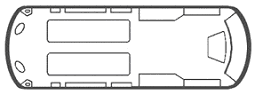
SYSTEMS General Overview: Located on the aft, dorsal bow of the ship, the shuttlebay module is accessed by a flight path between the nacelles. The standard shuttle bay module contains facilities to refuel/rearm, to repair, and to provide routine maintenance to the shuttle complement assigned to the ship. A flight control room, known as "Flight Ops", controls the shuttle bay and directs flight vectors for incoming and outgoing craft. This is located against the forward wall of the shuttlebay, next to the exit for the turbolift on deck 4. The Flight Control Officer's office is located adjacent to the Flight Ops center. It is decorated to the FCO's preferences and contains a work area, a personal viewscreen, a computer display, a replicator, and a washroom/head. CL and CLU Shuttlebay The standard shuttlebay (CL and CLU only) contains the following:
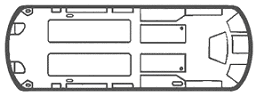
LCL Shuttle Bay: The LCL variant of the Steamrunner class has an enlarged shuttle bay module, to accommodate the extra size of the shuttles utilized for troop transport and landing operations. Flight Ops is located in the same position as on the CL/CLU, and serves the same function. The LCL shuttlebay contains the following:
9.2.1 TYPE-15 SHUTTLEPOD
Type:
Light short-range sublight shuttle. The Type-15 Shuttlepod is a two person craft primarily used for short-ranged transportations of personnel and cargo, as well as for extravehicular inspections of Federation starships, stations and associated facilities. Lacking the ability to obtain warp speeds, the Type-15 is a poor candidate for even interplanetary travel, and is traditionally used as a means of transport between objects only a few kilometers apart. The craft is capable of atmospheric flight, allowing for routine flights between orbiting craft or stations and planetside facilities. Ships of this type are stationed aboard various starship classes and stations, both spaceborne and planetside. A variant of this type, the Type-15A Shuttlepod, shares the same specifications of its sister craft, but is capable of reaching a maximum delta-v of 13,200 m/sec. The Type-15A was a limited production craft and the information gained from its service allowed for further streamlining of what would eventually become the Type-16 Shuttlepod. Still, the 15A remains in active service, and existing Type-15 spaceframes can easily be converted to the 15A provided that off the shelf parts are available. However, it should be noted that Starfleet Operations has deemed that the 15A spaceframe exhausts its fuel supply rather quickly and its production at major assembly plants is now discontinued.
9.2.2 TYPE-18 SHUTTLEPOD Type:
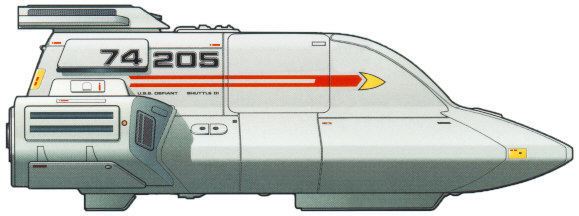
Medium short-range sublight shuttle. Developed in the mid-2360s, the Type-18 Shuttlepod is somewhat of a departure from the traditional layout for ships of its size. In response to the growing threat of conflicts with various galactic powers bordering or near to the Federation, this shuttlepod was designed to handle more vigorous assignments that still fell into the short-range roles of a shuttlepods. Even with her parent vessel under attack, the Type-18 was designed to function in battle situations and could even be used as an escape vehicle should the need arise. Lacking a warp core, the pod is a poor choice for travel beyond several million kilometers. Ships of this type are seeing limited deployment on various border patrol and defensive starship classes, including the Defiant-, Sabre-, and Steamrunner-class.
9.2.3 TYPE-8 PERSONNEL SHUTTLECRAFT Type:
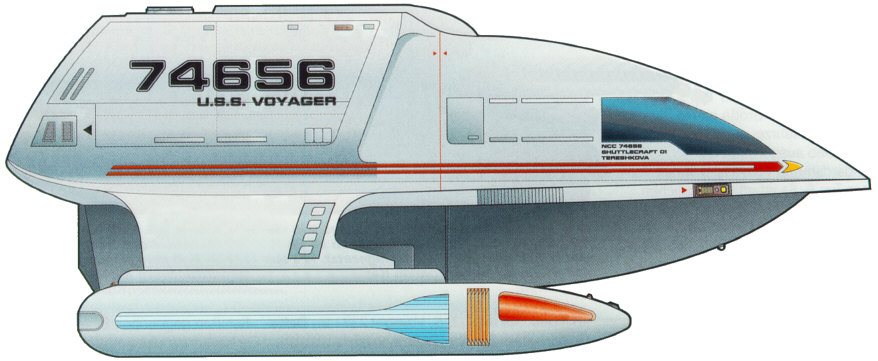
Light long-range warp shuttle. Based upon the frame of the Type-6, the Type-8 Shuttlecraft is the most capable follow-up in the realm of personnel shuttles. Only slightly larger, the Type-8 is equipped with a medium-range transporter and has the ability to travel within a planet’s atmosphere. With a large cargo area that can also seat six passengers, the shuttle is a capable transport craft. Slowly replacing its elder parent craft, the Type-8 is now seeing rapid deployment on all medium to large starships, as well as to Starbases and stations throughout the Federation.
9.2.4 TYPE-10 PERSONNEL SHUTTLECRAFT Type:
Heavy long-range warp shuttle. Developed specifically for the Defiant-class starship project, the Type-10 Personnel Shuttle is the largest departure from the traditional role of an auxiliary craft that Starfleet has made in the past century. Short of a dedicated fighter craft, the Type-10 is one of the most powerful auxiliary ships, with only the bulkier Type-11 being more heavily equipped. Nonetheless, the shuttle sports increased hull armor and the addition of micro-torpedo launchers, as well as a suite of tactical jamming devices. A larger warp coil assembly, as well as torpedo stores, makes the Type-10 much more heavier then other shuttles. Elements from the Defiant-class project that were incorporated into the shuttle include armored bussard collectors, as well as a complex plasma venting system for use during possible warp core breech situations. This bulky craft is equipped with a powerful navigation deflector that allows it to travel at high-warp, and a complex sensor system makes this shuttle suitable for reconnaissance work. Able to hold its own in battle situations, the Type-10 is seeing limited deployment on Defiant-class starships, as well as border patrol vessels and combat-ready ships.
9.2.5 TYPE-9A PERSONNEL SHUTTLECRAFT Type:
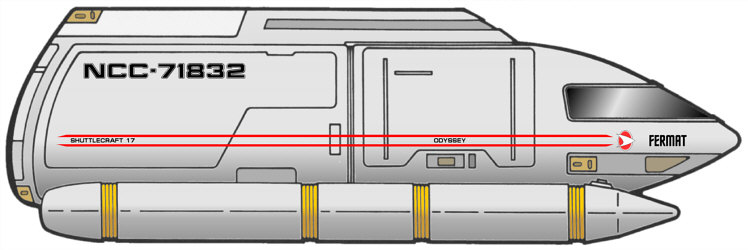
Heavy long-range warp shuttle. Short of a full-fledged transport ship, the Type-9A Cargo Shuttle is the primary shuttle of choice for cargo runs at major Starfleet facilities. Originally developed by the ASDB team stationed at Utopia Planitia, the 9A served as cargo vessel that carried components from the surface of Mars to the facilities in orbit. While able to travel at warp velocities, the 9A is somewhat slow at sub-light speeds, especially when carrying large amounts of cargo. The front of the shuttle is divided by a wall with a closable hatch, allowing for the aft area to be opened to the vacuum of space. The 9A also has the ability to carry one Sphinx Workpod in the aft area. A medium-range transporter and atmospheric flight capabilities allow it to easily complete its tasks. While rarely seen stationed aboard all but the largest starships, the Type-9A is a common site at any large Starfleet facility. In response to the need to transporter ground troops into areas heavily shielded, a variant designated the Type-9B was designed and is capable of carrying 40 troops and their equipment to the surface of a planet or interior of a space station. This variant has seen limited service onboard frontline ships, most notably the Steamrunner-class starship. Major technological advancements in the 2370’s allowed for further upgrades to be made to the engine systems aboard shuttlecraft. These upgrades make this craft more capable of long-range spaceflight and, like its starship counterparts, no longer damages subspace.
10.0 STEAMRUNNER
CLASS FLIGHT
OPERATIONS Operations aboard a Steamrunner class starship fall under one of four categories: flight operations, primary mission operations, secondary mission operations, and flight deck operations. Flight Operations are all operations that relate directly to the function of the starship itself, which include power generation, starship upkeep, environmental systems, and any other system that is maintained and used to keep the vessel space worthy. Primary Mission Operations entail all tasks assigned and directed from the Main Bridge, and typically require full control and discretion over ship navigation and ship's resources. Secondary Mission operations are those operations that are not under the direct control of the Main Bridge, but do not impact Primary Mission Operations. Some examples of secondary mission operations include long-range cultural, diplomatic or scientific programs run by independent or semi-autonomous groups aboard the starship. Flight Deck Operations are those operations that typically fall under Secondary Mission operations, but fall under the control of the Tactical Information Center. It is not uncommon for Flight Deck Operations to supercede Primary Mission Operations, particularly in combat missions.
The Steamrunner class, as a Light Cruiser, is a highly modular structure that can be adapted relatively quickly (days to weeks) to mission goals assigned to it. While any Steamrunner can be assigned to any mission, to truly be effective a change in modules may be required. The following lists the current missions and structural modifications for the CLU. If there are no structural changes, then the standard layout as described in this document is the optimal design:
Structural changes: Diplomatic facilities are almost eliminated and the Science department is also reduced to allow for greater torpedo storage, larger torpedo manufacturing facilities, increased number of security/combat personnel, increased number of shield generators, redundant communication equipment, and increased ablative armor to the hull.
Structural changes: Additional laboratories, probes, and mission specific experiments/equipment are installed as the mission dictates. Typically there is a decrease in weapon loadout, and in diplomatic facilities.
Structural changes: Additional VIP quarters, conference rooms, private meeting rooms, formal dining facilities, recreational facilities, and improved, secure communications can be installed as the mission dictates. Typically, weapons loadout and science departments are reduced to allow for the extra diplomatic facilities.
The normal flight and mission operations of the Steamrunner class starship are conducted in accordance with a variety of Starfleet standard operating rules, determined by the current operational state of the starship. These operational states are determined by the Commanding Officer, although in certain specific cases, the Computer can automatically adjust to a higher alert status. The major operating modes are:
During Cruise Mode, the ship’s operations are run on three 8-hour shifts designated Alpha, Beta, and Gamma. Should a crisis develop, it may revert to a four-shift system of six hours to keep crew fatigue down. Typical Shift command is as follows:
Due to the unique shape of her hull, the Steamrunner class does not have a separated flight mode. While the hull can eject the secondary hull assembly quickly, her lack of a clearly identifiable saucer section precludes independent operations.
Due to the unique shape of her hull, the Steamrunner class cannot land within a gravity well and maintain hull integrity for Trans-atmospheric operations. This does not mean that the hull cannot withstand a landing - quite the contrary, in an extreme emergency, the Steamrunner class could effect a surface landing while only losing an estimated 15% of hull integrity while structural members are estimated to have failure rates as high as 65%. While integrity is not high enough to allow for deep-space operations, enough of the internal volume and structural members should remain to allow for a landing that is safe for her crew. See section 11.4 for additional information.
Though
much of
a modern starship’s systems are automated, they do require
regular maintenance
and upgrade. Maintenance is typically the purview of the Engineering,
but
personnel from certain divisions that are more familiar with them can
also
maintain specific systems. Level 1 Diagnostic - This refers to the most comprehensive type of system diagnostic, which is normally conducted on ship's systems. Extensive automated diagnostic routines are performed, but a Level 1 diagnostic requires a team of crew members to physically verify operation of system mechanisms and to system readings, rather than depending on the automated programs, thereby guarding against possible malfunctions in self-testing hardware and software. Level 1 diagnostics on major systems can take several hours, and in many cases, the subject system must be taken off-line for all tests to be performed. Level 2 Diagnostic - This refers to a comprehensive system diagnostic protocol, which, like a Level 1, involves extensive automated routines, but requires crew verification of fewer operational elements. This yields a somewhat less reliable system analysis, but is a procedure that can be conducted in less than half the time of the more complex tests. Level 3 Diagnostic - This protocol is similar to Level 1 and 2 diagnostics but involves crew verification of only key mechanics and systems readings. Level 3 diagnostics are intended to be performed in ten minutes or less. Level 4 Diagnostic - This automated procedure is intended for use whenever trouble is suspected with a given system. This protocol is similar to Level 5, but involves more sophisticated batteries of automated diagnostics. For most systems, Level 4 diagnostics can be performed in less than 30 seconds. Level 5 Diagnostic - This automated procedure is intended for routine use to verify system performance. Level 5 diagnostics, which usually require less than 2.5 seconds, are typically performed on most systems on at least a daily basis, and are also performed during crisis situations when time and system resources are carefully managed.
11.1 EMERGENCY MEDICAL OPERATIONS Pursuant to Starfleet General Policy and Starfleet Medical Emergency Operations, at least 40% of the officers and crew of the Steamrunner class are cross-trained to serve as Emergency Medical Technicians, triage specialists, medics, and other emergency medical functions along with non-medical emergency operations in engineering or tactical departments. This set of policies was established due to the wide variety of emergencies, both medical and otherwise, that a Federation Starship could respond to on any given mission. The observation lounge on deck 5 can serve as a treatment ward while the VIP/guest quarters on deck 3 can serve as emergency intensive care wards, with an estimated online activation time of 30 minutes with maximum engineering support. Further, the Shuttle bay has a mobile hospital that can be deployed either on the flight deck, or transported to the Cargo Bays for emergency overflow triage centers. The Cargo Bays also provides for the emergency atmosphere recalibration to type H,K, or L environments, intended for non-humanoid casualties. All facilities are equipped with full Biohazard suites, to minimize and prevent crew exposure to potentially deadly diseases.
Ever present is the possibility that a ship will become disabled or otherwise damaged to such extent that it can no longer support life. In such situations the crew has to option of abandoning ship by using the Escape Pod system. Each 8-person pod has life support for 3 months in space, and has a maximum speed of 4,200 m/sec. Subspace radio and beacon are permanently activated once the pod is ejected from the ship, to aid in locating the pod. Escaped pods have atmospheric entry and landing capability. There are no escape pods connected to the bridge. Pods are located on all decks below Deck two. Two pods are reserved for the top four officers in the chain of command, because they are the last four to leave the ship. As the number of experienced Captains dwindles in Starfleet, the notion of a Captain going down with his ship has been abolished. If the ship is abandoned, the top four officers in the chain of command will wait until everyone else is off the ship, opt to arm the auto-Destruct (not always necessary, but there if needed), and then leave in the two escape pods.
11.3
RESCUE AND EVACUATION
OPERATIONS Rescue and Evacuation Operations for a Steamrunner class starship will fall into one of two categories - abandoning the starship, or rescue and evacuation from a planetary body or another starship. Rescue Scenarios Resources are available for rescue and evacuation to a Steamrunner class starship include:
Abandon-Ship Scenarios Resources available for abandon-ship scenarios from a Steamrunner class starship include:
11.4
EMERGENCY LANDING OF
PRIMARY HULL In the event of a planetary body being within reach of a disabled Steamrunner class vessel, a landing of the primary hull can be attempted. The basic procedure for atmospheric entry includes jettisoning warp core and antimatter pods prior to entry. Explosive charges set within the Nacelle pylons are detonated, separating the nacelles and primary hull from the pylons and the secondary hull. Entry is controlled with impulse and thrusters, while IDF and SIF are maintained. Flight path is determined and the primary hull is guided into a sliding landing. Data from a previous successful landing by a Steamrunner class vessel was incorporated into the emergency routines of other vessels, including Galaxy class saucer landings.
APPENDIX
A - VARIANT DESIGNATIONS
CL - Light
Cruiser
APPENDIX
B - BASIC
TECHNICAL SPECIFICATIONS
ACCOMMODATION Officers and Crew
228 (455 for LCL) DIMENSIONS Overall
Length 300.98 meters PERFORMANCE Maximum Velocity warp 9.7 (12 hours maximum) ARMAMENT CL - 3
Type IX phasers, 4 Type VIII phasers, 4 photon torpedo launchers
[2 tube], 2 fore and 2 aft TRANSPORT EQUIPMENT Shuttlecraft (CL and CLU)
Shuttlecraft (LCL)
Transporters (CL and CLU)
Transporters (LCL)
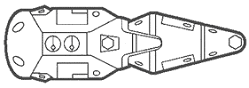
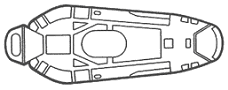
Primary Hull
Secondary Hull
This is the one point in this entire page where you'll find that, for the first time, the authors step out of the Star Trek universe and back into our own 20th Century mindset. The information presented on this page is a result of hours and hours worth of researching, more researching and then a rigorous and intensive process of compiling the best information from canon sources, and making an attempt to fill in the blanks. For the purposes of ST:ACTD, these are the specs for the Steamrunner-class vessel. Now to address some of the problems found in compiling this information followed by a brief explanation as to why a certain path was taken in these specs. Variants: The Specs Team decided that the Steamrunner was a Light Cruiser, and as such would not have multi-mission capabilities. Well at least not full multi-mission capabilities, such as the Galaxy can do. We felt that the Steamrunner would require some modifications to efficiently complete some mission types. So, the mission variants were created. Since there is no cannon data, I created the variants to provide a logical, and hopefully, fun playing field. The LCL variant is totally of my design. I based this off a jpg I found on the Internet showing a larger than normal shuttlebay behind the bridge. Since I really wanted to use the picture, I created this variant as a troop transport. Decks: This version of the Steamrunner, versus the old ST:ACTD specs, has lost 8 decks. This was because the specs team decided a deck height of 4.85m would be the standard. After fully measuring out the Steamrunner in the ST Ency II, and comparing it to ships of know length and height, it was shown that the Steamrunner was only 50.7m high. So we lost almost half of our ship (I was on the Steamrunner USS Quirinus) Phaser count: In almost every description of the Steamrunner I have looked at, it is almost always said to be "heavily armed". My initial view of the ship was that it had only one phaser strip that was (stupidly, in my opinion) recessed within the top side of the ship. This severely limits the field of fire for this phaser array. Looking at the movie First Contact, the only visible attack by a Steamrunner is a phaser shot from the underside of the main saucer. To me this did not make the ship 'heavily armed'. My first thoughts were shaped by the game ST Armada, where it states the Steamrunner is a torpedo boat, that sits backs an lobs torps at the enemy. A thorough discussion by the specs team pointed out several possible arrays scattered around the ship. So in the end, I counted out 7 possible arrays, that logically (for me at least) cover all the space around the ship. Plus 7 type X phasers array would make this medium sized ship 'heavily armed'. The 4 torpedo tubes I placed, just as a nod to my original idea of a torpedo boat.
APPENDIX
E - CREDITS
AND COPYRIGHT INFORMATION
STEAMRUNNER CLASS SPECIFICATIONS CREATED BY: ROBERT PATE SOURCES USED:
Copyright 2001 - Star Trek: A Call to Duty. Use of these specifications is restricted to the Star Trek: A Call to Duty (ST:ACTD) Technical Specifications domain at http://techspecs.acalltoduty.com and may only be reproduced with the express permission of the ST:ACTD on sites that clearly serve to provide information on ST:ACTD, its various ships and stations, or other related topics. Editing the contents of the information present on this page or reformatting the way in which it is presented is not permitted without the direct permission of ST:ACTD. Wherever possible, published sources were consulted to add to the wealth of knowledge in this document, and in some cases, this text was reproduced here. Sources used are properly cited in the "Credits and Copyright Information" appendix. No copyright infringement is intended.
|








|
|
|
 |
 Copyright 2001 -
Star Trek:
A Call To Duty, all rights reserved (herein referred to as the
'ST:ACTD'). STAR TREK and related marks, symbols, and
materials are trademarks of Paramount Pictures Corporation.
Unless noted otherwise, all material on this website, including but not
limited to images, audio, and text material (collectively the
"Material"), is protected by copyright owned or controlled by the
ST:ACTD, unless otherwise indicated. UNAUTHORIZED COPYING,
REPRODUCTION, REPUBLISHING, UPLOADING, DOWNLOADING, POSTING,
TRANSMITTING OR DUPLICATING OF ANY OF THE MATERIAL WITHOUT EXPRESS
PERMISSION IS PROHIBITED. Copyright 2001 -
Star Trek:
A Call To Duty, all rights reserved (herein referred to as the
'ST:ACTD'). STAR TREK and related marks, symbols, and
materials are trademarks of Paramount Pictures Corporation.
Unless noted otherwise, all material on this website, including but not
limited to images, audio, and text material (collectively the
"Material"), is protected by copyright owned or controlled by the
ST:ACTD, unless otherwise indicated. UNAUTHORIZED COPYING,
REPRODUCTION, REPUBLISHING, UPLOADING, DOWNLOADING, POSTING,
TRANSMITTING OR DUPLICATING OF ANY OF THE MATERIAL WITHOUT EXPRESS
PERMISSION IS PROHIBITED. |
||
